
Don’t leave prospective customers baffled
If yours is like most retail dive stores, over half of all first-time visitors to your website are seeking the answer to the same question. That is, How do I become certified? Unfortunately, with many dive store websites, answering this question involves:
- Navigating through multiple pages.
- Deciphering obscure terminology.
- Coping with incomplete information.
If this is true of your website, it may cost you valuable business. In this article, we will show you how to avoid common mistakes.
Don’t make them hunt for it
The people who come to your website have no interest in reading your copious prose. They simply want to get to the information they came for quickly.
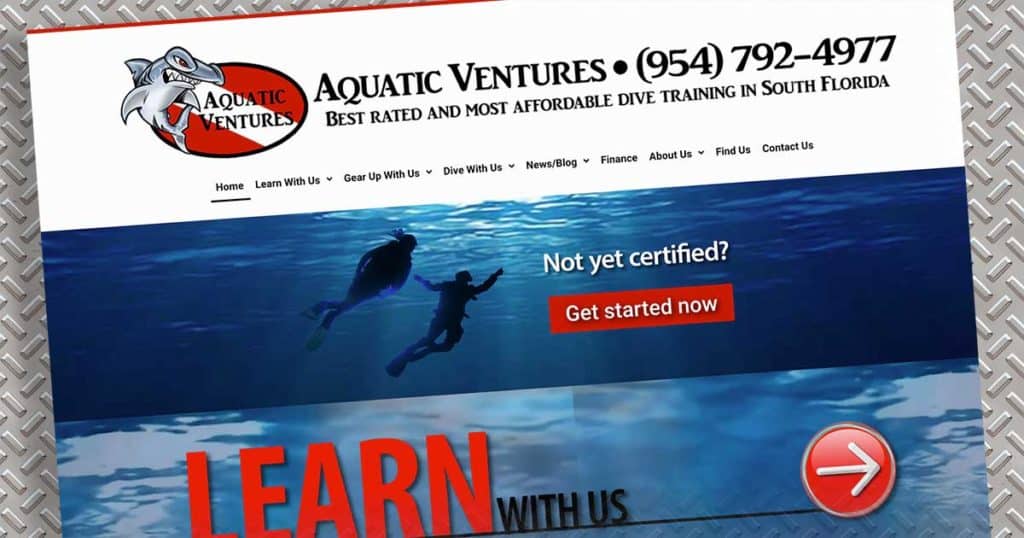
Ideally, there will be a single, very prominent button at or near the top of your home page that will say something to the effect of, Become a certified diver. Clicking this button will take visitors directly to your Open Water Diver course page.
Few visitors will get that far if this page is more than two clicks from your home page. Also, if the link to this page is anywhere other than at or near the very top of your home page, few visitors will scroll down far enough to see it.
Use terms prospective students will understand
Don’t assume visitors to your website will know what an Open Water Diver course is. They very well may not. They do, however, know that their goal is to become a certified diver. Therefore, a link that reads Become a certified diver will be far more effective than one that simply says Open Water Diver course.
Also, unless you operate in a resort environment, your Open Water Diver course link should not be the third or fourth item in a list of courses. It belongs at the top as this is what most visitors are after.
The exception will be if you operate in a resort setting. In this case, you will probably want your discovery experience to be at the top of the list.
Answer as many additional questions as possible
People hate to read and will do anything they can to avoid doing so. Nevertheless, if your learn-to-dive page fails to answer most prospective students’ questions, they will choose a dive operator whose website does. Among the questions your learn-to-dive page must answer:
- What is involved?
- How much does it cost, and what does this include?
- When do classes take place?
When explaining what is involved, you want to keep things as brief as possible. If you can arrange to have a short video that does this, all the better. We provide a link to such a video below.
The simpler you can keep your pricing structure, the better. Even though you provide a detailed breakdown of costs, anything students must pay over and above the basic course fee will appear to them are though you are nickel-and-diming them.
While it is common for stores to embed something like a Google calendar showing all their classes and activities, prospective students should not have to hunt through this to find just the beginning course starting dates. Have a list of upcoming Open Water Diver course dates on your learn-to-dive page in addition to what may appear on your calendar.
See an example
The link below will take you to an actual dive store website that exemplifies everything discussed in this article. Aquatic Ventures in Fort Lauderdale trains several hundred beginning divers every year. You could learn a lot from them.