
Don’t play the game? Then don’t make the rules.
Do the people who create your training agency’s standards and materials actively dive and teach? You would certainly hope so. But in too many instances, that’s not the case.
Hard to believe, but…
In the early 1980s, a friend of ours spent two years working for NAUI. Because he was actively involved in creating training materials and standards, he made a point to teach at least one entry-level scuba course every month, as well as various continuing education and leadership-level courses. He felt this was essential in doing his job.
Then, he was hired by another organization. We’ll just refer to them as the Giant Association of Scuba Professionals (GASP).
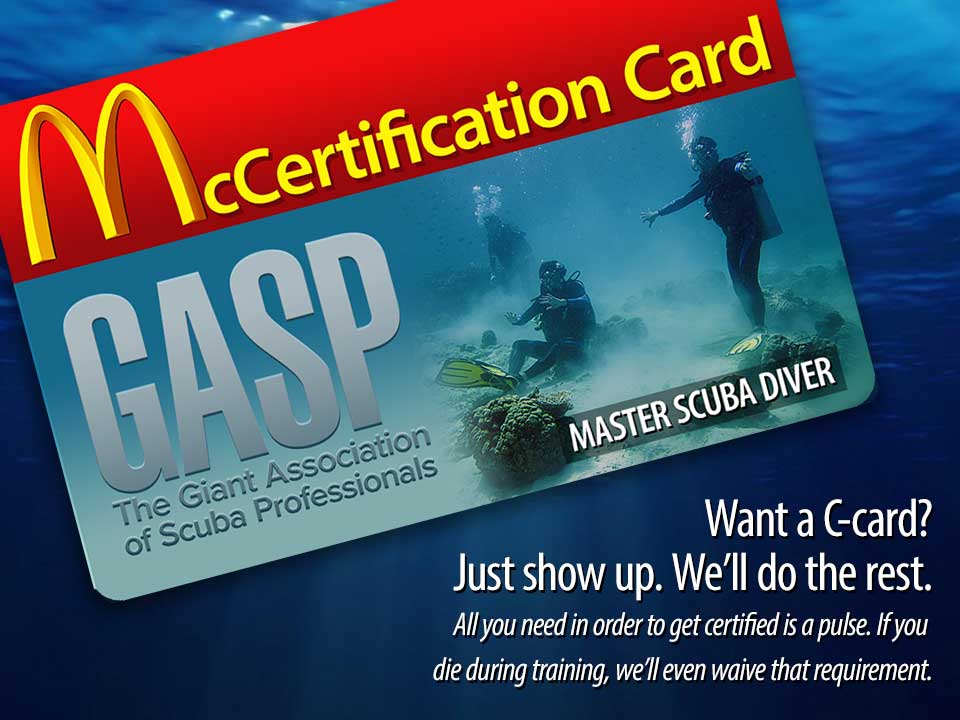
He started his job on April Fool’s Day, 1982. And as a consequence, initially thought that what he was hearing was a joke. Sadly, it wasn’t.
Upon being called into his boss’s office, he was asked if he still taught scuba. “Of course I do; I teach at least one beginning class every month,” he replied, thinking this would score points with his boss.
“Well,” the boss said, “You need to stop.” Insofar as our friend’s new job involved contributing to the development of training materials, he could not help but ask why.
This would have made sense if our friend’s boss had told him that it was because the company did not want him teaching in competition with their member stores and instructors. But that’s not what he was told.
The explanation he got was, “If one of your students has a heart attack during training, it will make us look bad.” Since the odds of this happening bordered on astronomical, this was clearly bullshit. As time passed, our friend began to figure out what was really going on.
Had our friend been allowed to continue teaching, he would have undoubtedly discovered several materials and standards that needed correction or improvement. But, since he was forbidden to teach, his bosses needn’t worry about the inconvenience.
During the five years our friend worked at GASP, he never once saw a member of upper management teach a class or even make a dive. It soon became apparent that it had been several years since any of them had done so.
We are told that, in the years since our friend worked at GASP, the problems he encountered aren’t as severe. Still, very few people who work at GASP are certified divers, and none actively teach. Most don’t even dive.
How the problem manifests itself
Any time a company’s management distances itself from its products, services and customers, problems ensue. Here is just one example.
In the 1970s, the most common format for teaching scuba was a class that met two evenings a week for three or four weeks. The first part of the evening would be spent in the classroom; the balance of the evening would be spent in the pool.
In 1978, GASP introduced its “modular” scuba course. It assumed you would spend the first night of the class explaining what the class entailed and what equipment students must buy. You would then finish the evening in the pool with the watermanship evaluation.
Over the next five evenings, you would do the five confined water “dives” required by standards. In the late 1970s and early 1980s, this worked. But more than 40 years later, very few dive centers still do this. Among other things, it is tough to find students willing to commit to such a time-consuming schedule.
Today, a one-weekend schedule is the most popular format for entry-level scuba courses. This involves either two pool sessions or one, very long one. A course with five confined water “dives” doesn’t fit easily in these time frames.
If anyone in the upper management at GASP taught scuba regularly, they’d see that their “modular” scuba course is in dire need of restructuring. But, since they don’t, they keep pretending it’s still 1978.
There is an alternative
Sadly, GASP’s shortcomings are not unique. Most of the people who run training agencies have surprisingly limited teaching experience. Almost none have owned or managed dive centers, resorts or dive charter operations. Yet, they have no difficulty telling you how you must teach or providing you with the materials to do so.
However, there is an exception. At SDI, nearly all of the headquarters’ staff are certified divers. A significant number are instructors, and most of them still teach. It makes a difference. A big difference.
SDI’s standards afford maximum flexibility to meet individual student needs and adapt to differences in teaching environments and schedules. What SDI charges for materials and services also helps ensure you can make diver training a profit center instead of a soul-sucking expense.
If you are tired of being straight jacketed by a training agency that has no difficulty dictating everything you must think, do and say, or who charges so much for its products and services you are forced to teach at a loss, call us. We can help you make teaching fun — and profitable — again.